
Turtle season has ended on Cousin Island Special Reserve. With the onset of the seabird breeding season, the team has moved back into the forest, censusing the seabirds and assessing seabird nests. During this time of year, the Pisonia (bwa mapou) trees produce their sticky seeds, which adhere to bird feathers, potentially rendering them flightless and ensnared.
Recently, Science Officer Chris Tagg was checking seabird nests when he noticed something move out of the corner of his eye. It was clear a bird had gotten snared in Pisonia. However, its mottled coloration gave him pause.
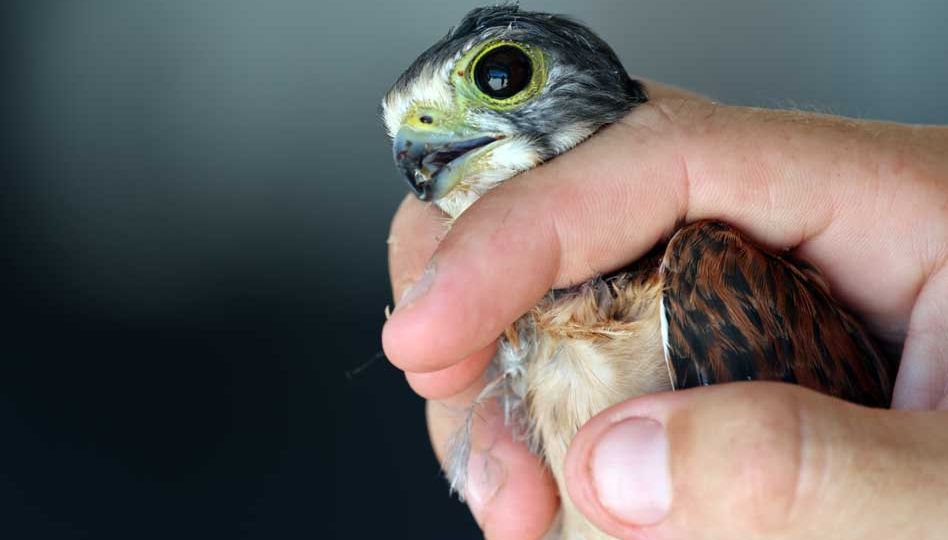
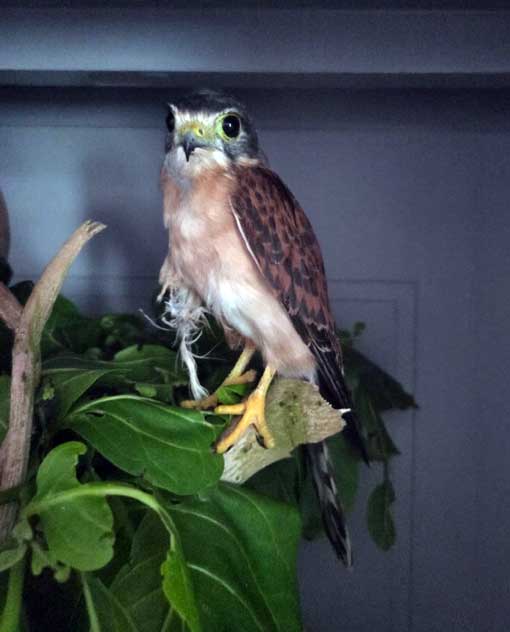
“That looks like a Kestrel… Oh! That is a Kestrel!” he exclaimed. Staring back at him with large, dark, alert eyes was the world’s smallest Kestrel, the Seychelles Kestrel (Falco araeus). Known as “Katiti” in Creole for its piercing calls during flight, this raptor feeds on insects and small vertebrates such as skinks and geckos. It spots its prey with sharp eyes and captures them using its equally sharp talons and beak.

The Pisonia (bwa mapou) trees produce their sticky seeds
This species has faced persecution in the past, as it was once considered a bad omen. While this is no longer the case, invasive rats and Myna birds still pose significant threats. The Seychelles Kestrel is confined to the islands of Mahé (including some of its satellites), Silhouette, Île du Nord, Praslin (and some of its satellites), and La Digue. There is no resident population on Cousin Island, where it is not commonly seen.
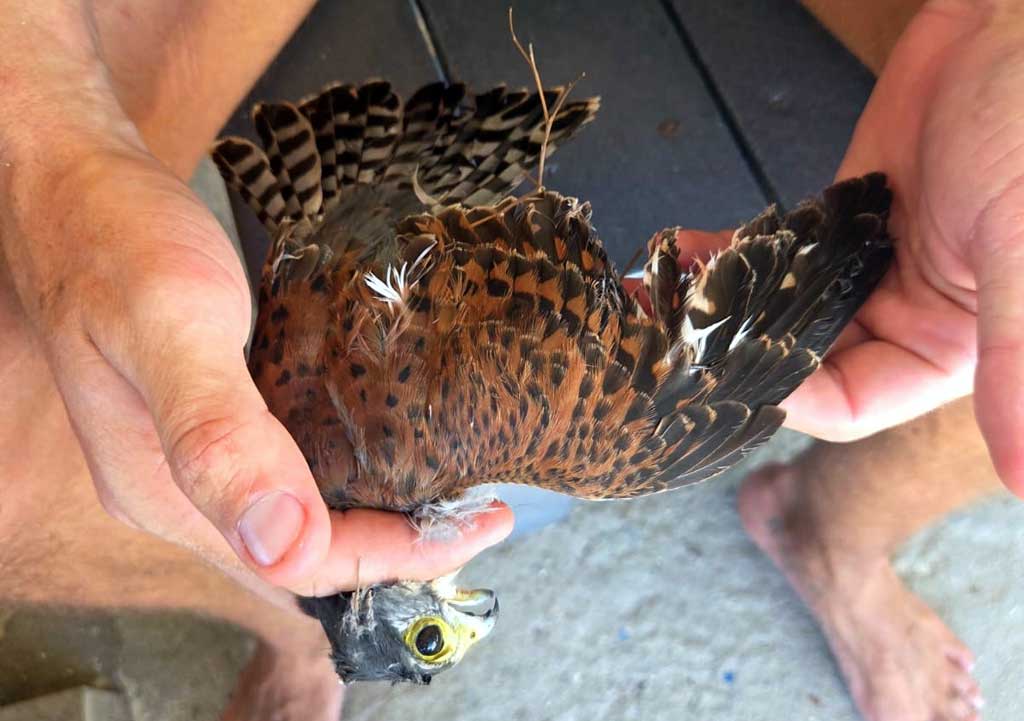
Unfortunately for this Kestrel, Pisonia is the most widespread tree on the island. While land birds on Cousin Island have learned to avoid this sticky trap, other birds, like the Kestrel, are not so fortunate. Upon inspection, the Kestrel appeared to have minimal Pisonia coverage, suggesting it had not been ensnared for long. It displayed many positive signs of good health.
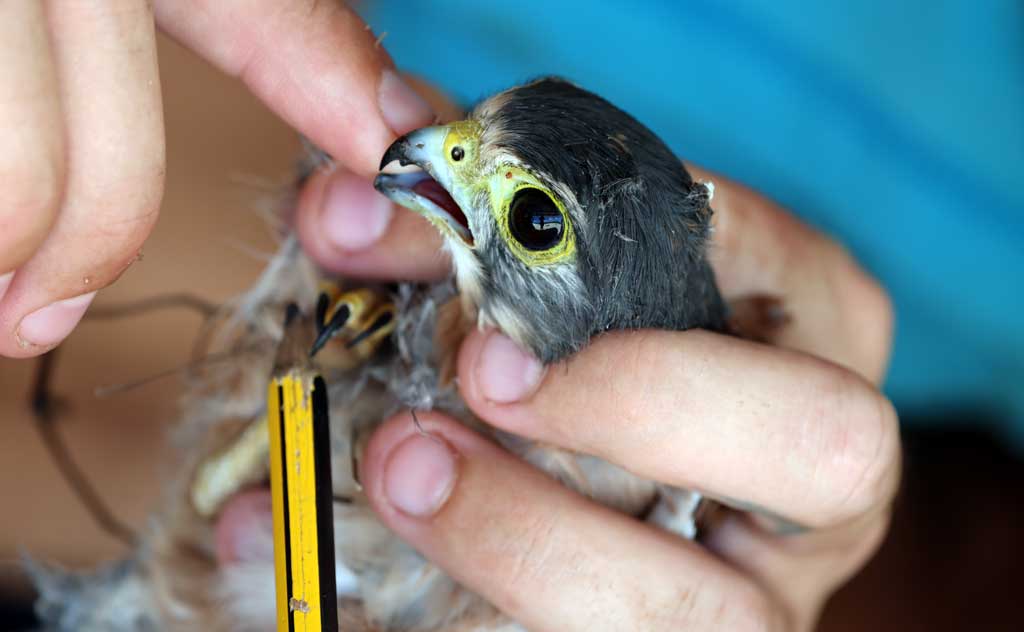
The Pisonia was removed piece by piece
The bird was carefully handled as the Pisonia was removed piece by piece, ensuring no further damage was done. Although its feistiness made the removal process more challenging, it was a reassuring sign that the bird was still healthy. Once completely free of Pisonia, the Kestrel was kept overnight on Cousin Island to be released in a suitable location on Praslin Island the next day.
During its overnight stay, a room in the volunteer dorm was converted into a temporary aviary, allowing the Kestrel to remain quiet and undisturbed. A shallow water tray and food were provided. It was encouraging to see that the Kestrel fed on the offered food, suggesting it was calm and not overly stressed.
The next day, the Kestrel was placed in a box and picked up by the Reef Rescuers, who successfully released it on Praslin Island, where it will hopefully avoid any further sticky situations.
It was released on Praslin Island